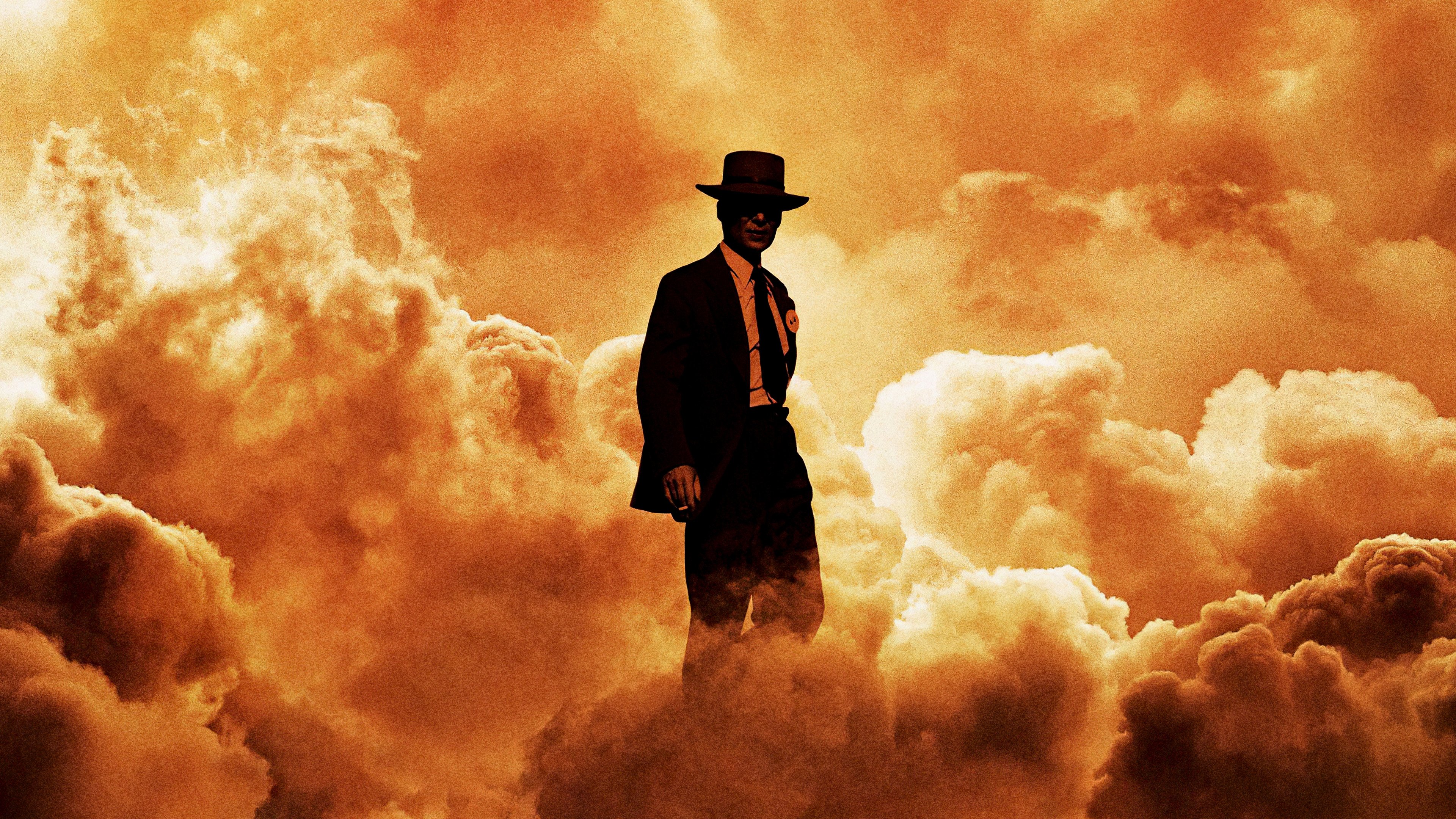
Nolan's structural gambit—threading the 1943–45 Manhattan Project, the 1954 AEC security hearing, and the 1959 Senate confirmation of Strauss through a single tripartite architecture—is the most intellectually honest thing this director has done since Memento proved he could make form feel like argument. The three timelines are not a puzzle to be solved so much as a moral equation: cause, reckoning, and the slow rot of institutional memory. What elevates the construction beyond mere cleverness is the color-to-monochrome shift, which isn't a stylistic tick but a philosophical statement about how the state reduces a living man to a file. The Los Alamos sequences, shot in saturated IMAX anamorphic, feel almost fever-dream in their urgency; the hearing rooms, drained to a surgical grey, feel like a dissection theater where a mind is poked and prodded for loyalty. The transition between registers is jarring in the best sense—it should be, because the film is arguing that the act of creation and the act of judgment are two different ontologies, and Nolan refuses to let you smooth over the violence of that gap.
Cillian Murphy is, simply, the performance of the decade. There is nothing "method" about it, nothing performative in the sense the word is now diluted by press junkets. Murphy plays Oppenheimer as a man whose body is a vessel for thought so dense it distorts the architecture of a room; you watch his shoulders, his hands, the particular way he holds a cigarette like a tuning fork, and you understand that this is an actor who has made the film's central thesis—genius as a kind of physical burden—into kinesiology. The ensemble orbits this gravitational center with varying success. Emily Blunt, as Katherine, is given the most substantive agency in a script that otherwise treats women as furniture and witness; her scenes with Murphy carry a ferocity the film's political sequences lack. Matthew McConaughey, as Strauss, is a tour de force in the final act, a man so thoroughly unmasked by memory that you cannot decide whether to pity or despise him, and Nolan is wise enough not to decide for you. Robert Downey Jr. as Teller, by contrast, is a caricature of a caricature—sharp, grinning, venomous—and one suspects the script needed a Teller who could be more ambiguous than the history allows, but Nolan chose legibility over discomfort, and that is the film's most consequential sin.
The middle ninety minutes, however, are where the architecture strains. The Los Alamos sequence, which should be the film's kinetic engine, becomes a series of increasingly schematic set-pieces: the race against the Germans, the internal Teller-Oppenheimer feud, the bureaucratic machinery of the project. Nolan treats the science as a MacGuffin he is too proud to discard but too politically cautious to interrogate. We are told what the bomb is in a single, almost glibly expository scene, and then we are not told much more. The film's genuine interest lies in what the bomb does to a man's relationship with power, and that interest is strongest in the hearing sequences, where the dialogue is sharp, the room is tight, and the politics are specific. When the film pulls back to spectacle—the final detonation sequence, rendered in an IMAX shot so prolonged it becomes almost liturgical—it is spectacular in the way a cathedral is spectacular: impressive, a little numbing, and ultimately a question of scale rather than meaning. The explosion is the one moment Nolan lets the image do the moral work for him, and it is the one moment the film feels least like itself.
What saves Oppenheimer from being a magnificent, overlong monument to a single director's need to be the most ambitious voice in the room is its final act, which lands with a quiet, devastating precision. The 1959 hearing, in which Strauss is denied a position of power by the very people he helped construct, is not a revenge plot; it is an indictment of the system that made both men, and Nolan stages it with a coldness that lets the cruelty breathe. The film's central question is not whether Oppenheimer was a hero or a monster. It is whether the machinery of the state can metabolize a conscience at all, and whether the man who built the weapon is the same man the weapon was built to protect. Nolan answers neither question. He does something harder: he makes the audience sit in the discomfort of a question with no clean resolution, and for three hours, that discomfort is the point. It is a flawed, overlong, occasionally self-indulgent film that nonetheless achieves something rare in contemporary cinema: the sense that a structure can be a moral argument, and that a single performance can hold the weight of an entire twentieth century.