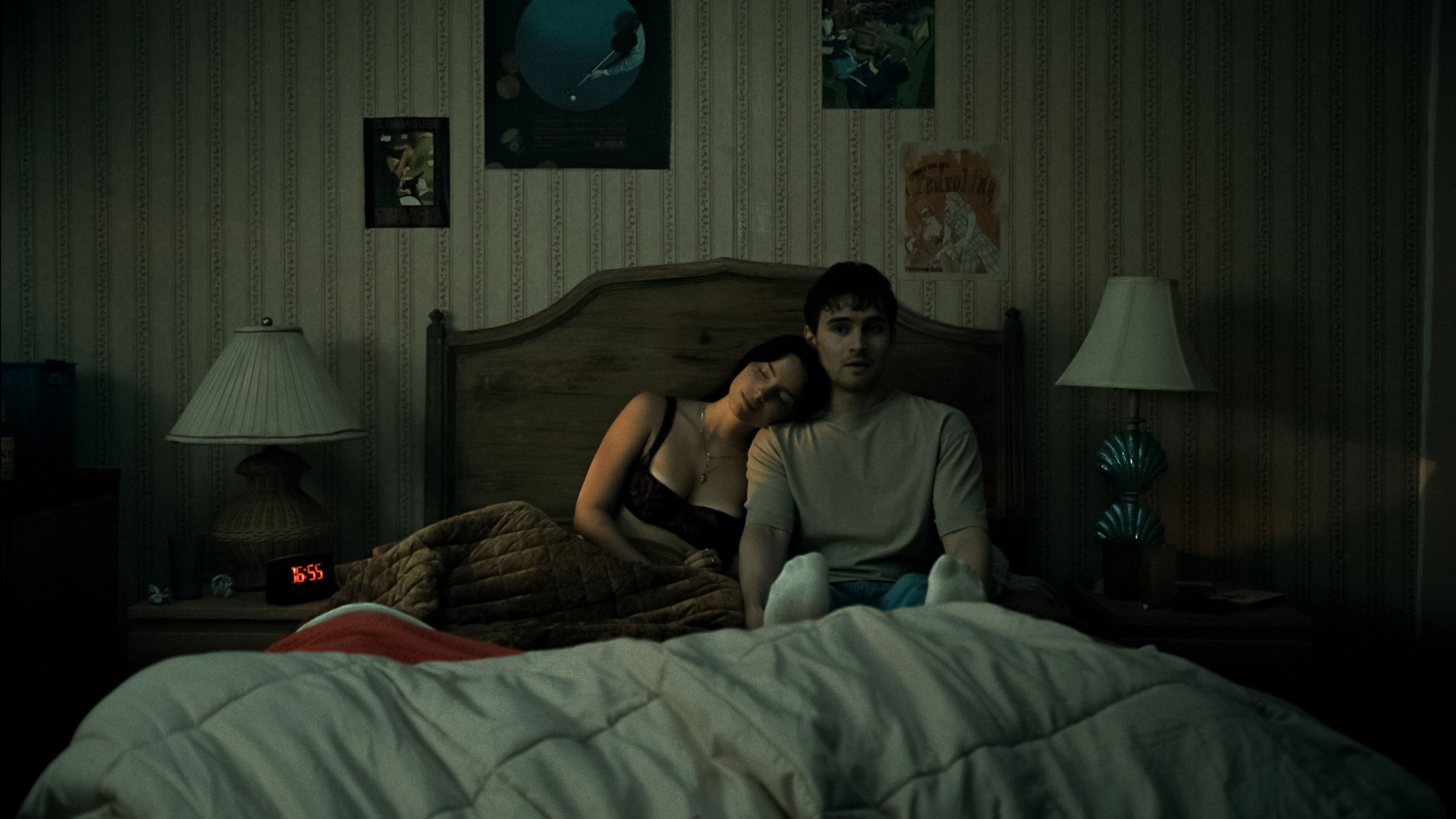
Curry Barker's Obsession opens like a wry romantic comedy and closes like a body-horror parable, and the distance between those two registers is where the film earns its existence. The inciting conceit—Bear, a music-shop clerk so inert he grieves his cat more than he confronts the woman beside him, purchasing a One Wish Willow stick from some New Age kiosk and spending it on "make Nikki love me more than anyone else"—isn't clever, but it's specific in a way that matters. Barker doesn't abstract the wish into a Faustian bargain or a generic curse. He roots it in the pathetic, small-maned ego of a man who cannot say "I like you" at a trivia night without the sentence dissolving into a three-year fantasy of mutual devotion. Michael Johnston plays that interiority with a flat, repressed stillness that makes the audience complicit in Bear's refusal to grow, and that complicity is the film's first knife-twist: we are meant to recognize ourselves in a man who treats another person's love as a problem to be solved with a novelty craft store.
The escalation from dream to nightmare lands with genuine physicality. Inde Navarrette's Nikki doesn't simply "go weird"; she becomes an architecture of violation—barricading doors, performing grief she hasn't experienced, constructing a domestic interior that is increasingly a cage built around a single occupant who no longer consents to its walls. The cat-meat sandwiches are the sequence that separates Obsession from the crowded shelf of psychological-horror films that mistake atmosphere for content. Barkley stages it almost banally: Bear bites into a lunch, the texture is wrong, the realization arrives in the throat before the mind. It's grotesque in the way that actual codependency is grotesque—intimate, inescapable, and delivered by someone who still says "I made it for you, Bear." Navarrette's performance in the corrupted register is a study in micro-expression: the eyes are Nikki's, the hands are not, and the audience is forced to watch two people occupy one body and argue in silence.
What makes the film genuinely uncomfortable rather than merely pulpy is its refusal to hand Bear a redemption arc. The moment he discovers the wish-corrupted presence has trapped Nikki's true consciousness in some purgatorial fold and chooses not to break the curse—because the alternative is sitting in that music shop with no fantasy, no validation, no proof that his existence registers in another person's life—Barker has turned the protagonist against the audience. We are no longer watching a man in trouble; we are watching a man in control, and the control is the horror. The "possession" of the title doubles: Nikki's body is possessed by the wish, but Bear possesses Nikki's narrative, her grief, her cat, her body, her lunch. The film's thesis is that forced intimacy is indistinguishable from small-scale vampirism, and it stakes that argument on a man's wounded romantic entitlement rather than on any external monster. That's a braver structural choice than 90 percent of the genre's output this year, and Barker earns it through patient, almost cruel pacing that lets the quiet scenes of Bear enjoying the arrangement sit beside the screaming ones without cutting away.
The film's principal weakness is its middle third, where Barker seems to lose confidence in the domestic register and leans on increasingly literal set-pieces—doors barricading, walls sweating, the willow stick sprouting black tendrils in the background of a kitchen scene that doesn't need them. These moments feel borrowed from a different, more conventional horror movie stapled into a script that was smarter than its own second act. But the final twenty minutes, in which Bear sits across from Nikki at a breakfast table and eats the sandwich again, pull the film back into a register of suffocating, inescapable quiet that makes the earlier spectacle feel like a misdirection. Obsession is not a perfect film. It is, however, a film that knows exactly what it's furious about, and it trusts its audience to sit in the ugliness without looking away. In a year of psychological horror that keeps mistaking "a woman is disturbed" for a thematic question, Barker's insistence that the real disturbance is the man at the table makes this the year's most necessary horror film.