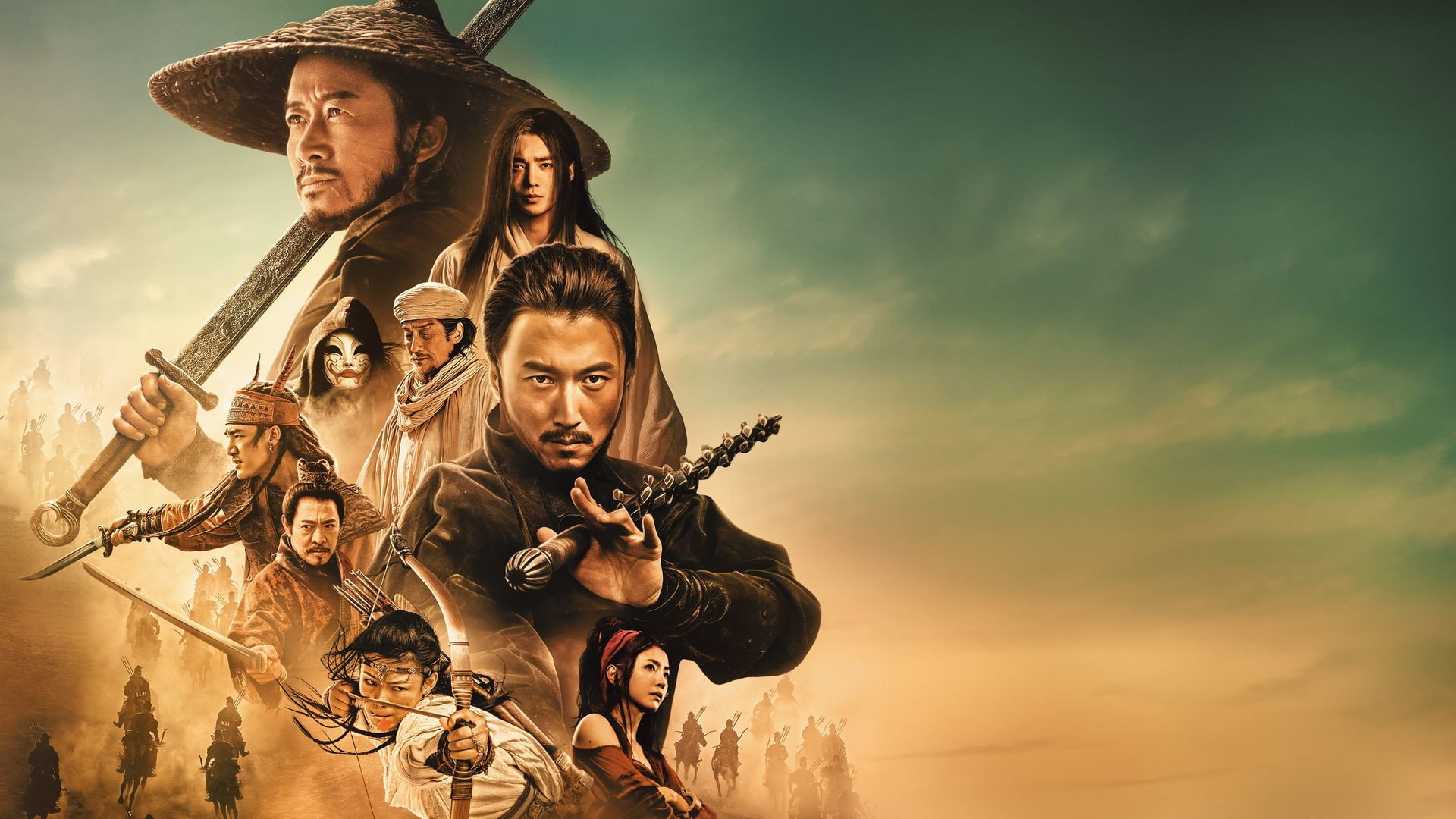
The title is a lie, and the film knows it. "Blades of the Guardians" announces a mythic register—guardians, blades, a dynasty's twilight—and then spends its 140 minutes dismantling every syllable. Dao Ma is not a guardian. He is a man with a contract and a bleeding left hand, hauling a silent, masked figure through sand that grinds against the lens with a sound design so granular and abrasive it borders on punitive. What distinguishes this from the hundredth desert-escort picture in Sino-language cinema is its refusal to let the landscape become poetry. The Western Regions here are not a philosophical backdrop; they are a logistical nightmare, and the film treats the traversal of them with the same unglamorous patience it affords the politics of the Sui court bleeding out in the background. You feel the heat on the back of your neck. You feel the weight of the pack. This is wuxia with the chi drained from its joints.
The combat sequences—there are perhaps seven, each shorter and uglier than the last—represent the film's most radical act. Practical swordplay in a genre that spent three decades perfecting the wire-fu ballet is not merely a stylistic choice; it is an argument. When Dao Ma catches a blade across the forearms and holds it there, breathing through clenched teeth, while the attacker's weight pins him into sand, the camera stays at chest height and does not cut. No slow motion. No rim lighting. The steel grinds. A knee buckles. The fight ends in four seconds with a throat opened and a body that hits the ground like a sack of grain, not a falling leaf. It is brutal in the way a surgeon is brutal—precise, indifferent, and over. The film trusts the audience to find meaning in the aftermath rather than the choreography, and in the three sequences where it does, it earns a visceral charge that the wire-fu tradition could only simulate.
Where the picture falters is in its second act, when the masked traveler finally sheds the mask and the narrative pivots from survival to political assassination with a speed that suggests the screenplay was written by two different people in two different rooms. The Sui Dynasty's collapse—forced corvée labor, the rebellion at Daxing, the emperor's paranoiac purges—is present in the background as a rumbling tectonic plate, but the film never lets Dao Ma's escort job become entangled with that history in a way that restructures his understanding of what he's carrying. The traveler is a MacGuffin dressed in silk, and the deconstructive framework, which had promised to strip wuxia of its archetypes, instead reinstates the very archetype it claimed to kill: the mysterious figure who changes the escort's world. The third act's political assassination set-piece is competent, even tense, but it reads as a historical thriller bolted onto a survival film, and the seam shows.
Still, "Blades of the Guardians" is more honest than 90 percent of what passes for period martial-arts cinema in 2026. It understands that the tradition it is deconstructing is, at its core, a story about power and its distribution—who gets to be a guardian, who gets to be a blade, who gets to be the thing carried. Dao Ma's final choice, whatever it is, lands with the quiet violence of a man who has been making that calculus for every mile of the crossing. The film does not resolve it. It does not need to. The sand keeps moving.